chronos-plg
Case Study
Objective
Build a research system that can answer a harder question than “did the model predict price direction?”:
Does a probabilistic BTC forecast create a repeatable net edge after realistic market frictions, and is the evidence strong enough to justify promotion?
Why This Is Difficult
Trading-model evaluation is unusually vulnerable to optimistic assumptions:
- future information can leak through feature construction or split design
- gross returns can disappear after fees, slippage, funding, and financing
- one favorable regime can dominate a short evaluation window
- parameter searches can reward fragile configurations
- a good forecast does not guarantee a good trading decision
Chronos-PLG treats these as system-design problems rather than footnotes.
System Design
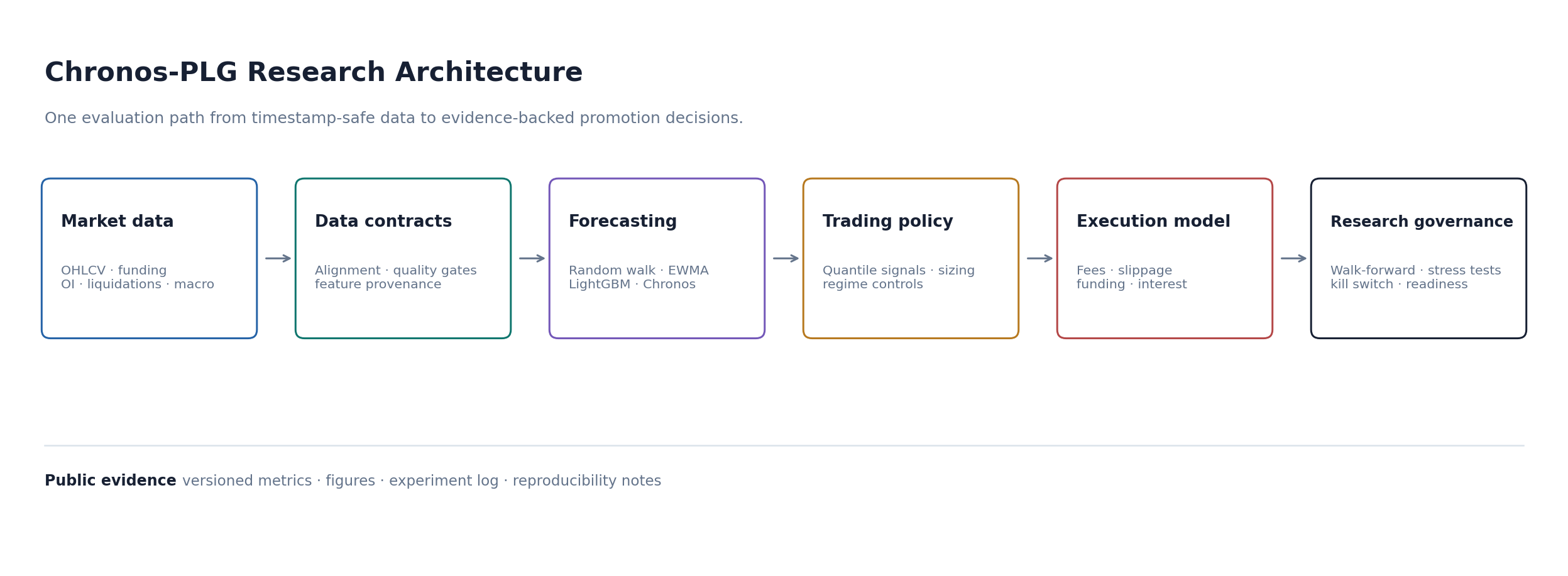
The same research path is reused from historical evaluation through paper replay:
- market data is validated for timestamp alignment, gaps, duplicates, and feature-family availability
- models produce return quantiles rather than a single point estimate
- strategy logic converts distributions into long, short, or abstain decisions
- the execution engine applies transition-aware costs
- walk-forward evaluation and stress protocols measure stability
- governance logic decides whether a candidate should advance, iterate, or stop
Model Stack
Statistical baselines
Random Walk and EWMA establish inexpensive, interpretable reference points.
Tabular quantile forecasting
LightGBM models estimate lower, median, and upper return quantiles from market and contextual features.
Time-series foundation model track
The Chronos runner uses strict rolling out-of-sample semantics and records model/backend provenance. Fallback execution is explicitly marked and cannot silently count as real Chronos evidence.
Meta-model
Chronos quantiles can be combined with tabular features through LightGBM. Stage-two training uses out-of-fold Chronos predictions rather than in-sample forecasts.
Evaluation Design
- expanding or rolling walk-forward folds
- frozen baseline protocol and fold schedule
- causal timestamp boundaries
- full net-cost accounting
- block-bootstrap uncertainty
- adverse-window and regime-exclusion stress
- parameter sensitivity and Pareto-style candidate ranking
- fixed-window paper campaign
Representative Findings
Positive but incomplete
The best inspected futures EWMA candidate produced:
Net PF = 1.1739Sharpe = 0.565376 trades
The result was classified as ITERATE, not ready for promotion.
Higher activity, weaker economics
The 1h spot and margin threshold calibration produced up to 197 trades, but net PF remained near 0.81 and Sharpe remained negative.
Attractive metrics, governance failure
A looser 4h threshold recovered:
- spot:
Net PF = 1.1517,Sharpe = 1.3640,145 trades - margin:
Net PF = 1.1346,Sharpe = 1.2199,145 trades
Both remained blocked by kill-switch behavior.
Fixed-window rejection
The selected spot campaign produced:
Net PF = 0.8509Sharpe = -0.822594 trades- promotion recommendation:
False
The negative campaign is useful evidence because the system rejected the candidate instead of converting a prior positive window into an unsupported deployment claim.
Engineering Decisions
Costs are part of the model contract
Fees, slippage, funding, interest, and other charges are computed as first-class execution events rather than an after-the-fact haircut.
Abstention is a valid prediction
Quantile width and expected edge can produce a no-trade decision. The policy is not forced to act on every forecast.
Promotion requires more than one metric
Net PF is the primary edge gate, but promotion also considers Sharpe, drawdown, trade count, stability, kill events, and recent-regime behavior.
Negative evidence is retained
Public artifacts include failed calibration and campaign results. This prevents the repository from becoming a collection of selected winners.
What The Project Demonstrates
- designing an end-to-end ML research system rather than a single model notebook
- building leakage-safe evaluation for temporal data
- separating forecast quality, trading quality, and deployment readiness
- implementing auditable model and strategy governance
- packaging research as reproducible code, tests, CI, figures, and public evidence
Current Limitations
- no inspected candidate is promotion-ready
- open-interest and liquidation coverage remains incomplete for important windows
- the strongest public evidence is EWMA-led rather than Chronos-led
- results remain sensitive to timeframe, threshold policy, and regime
Next Research Questions
- Does real-backend Chronos improve probabilistic forecast quality over the strongest baseline?
- Can forecast calibration improvements survive downstream costs?
- Does restored open-interest and liquidation coverage improve regime discrimination?
- Can a learned abstention policy improve readiness without overfitting?
- Does cross-asset context from ETH or broader markets add stable information?